
Stocks Slip to Start the Week
These are the main moves in markets:
Stocks
- S&P 500 Index declined 0,95% as of 9:30 a.m. New York time.
- Nasdaq 100 Index fells 0.7%.
- The Stoxx Europe 600 Index fell 0.9%.
- The MSCI Asia Pacific Index gained 0.6%.
Currencies
- The Bloomberg Dollar Spot Index advanced 0.5%.
- The euro declined 0.1% to $1.0825.
- The British pound sank 0.7% to $1.2319.
- The Japanese yen weakened 0.6% to 107.29 per dollar.
Bonds
- The yield on 10-year Treasuries declined less than one basis point to 0.68%.
- Germany’s 10-year yield climbed two basis points to -0.52%.
- Britain’s 10-year yield increased two basis points to 0.255%.
- The Canada 10-year government bond yield fell less than one basis point to 0.58%.
Commodities
- West Texas Intermediate crude climbed 3% to $25.49 a barrel.
- Gold was little changed at $1,703.10 an ounce.
- LME copper fell 0.3% to $5,257 per metric ton.
S&P 500 futures and European indexes were lower after a mixed session in Asia
Global stocks slipped Monday as investors weighed the benefits of reviving economic activity against the cost of a potential resurgence in infections that could lead to renewed lockdowns.
Futures linked to the S&P 500 index fell 1.1%, following a week in which the U.S. stocks gauge gained 3.5%. The benchmark Stoxx Europe 600 index was down 1%.
South Korea is serving as a cautionary tale for investors, after the biggest one-day increase in new infections in a month prompted the government to warn that the nation must brace for a second wave. Meanwhile, British Prime Minister Boris Johnson is joining authorities in Germany and some U.S. states in easing restrictions. On Sunday, Mr. Johnson laid out a three-step plan to ease the U.K. lockdown measures, including allowing staff in the construction and manufacturing industries to return to work as early as Monday.
Any decision to reopen U.K. businesses could be reversed if cases tick up, and the public could be unwilling to visit shops and restaurants even when the government allows them to reopen, Richard McGuire, head of rates strategy at Rabobank, cautioned.
In a sign that the economic damage may be more extensive than the rebound in stock markets suggest, factory furloughs across the U.S. are becoming permanent closings. Those factory shutdowns are likely to further erode an industrial workforce that has been shrinking as a share of the overall U.S. economy for decades.
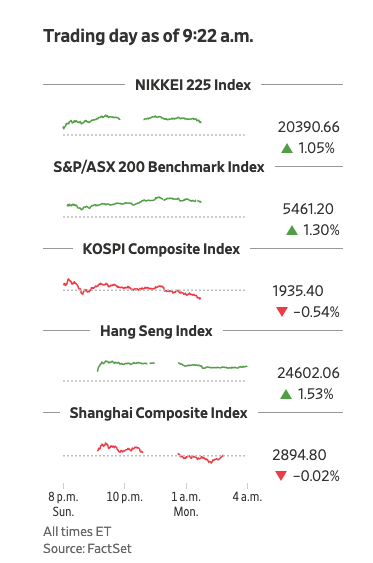
In Asia, Hong Kong’s Hang Seng Index closed up 1.5% higher, while Japan’s Nikkei 225 advanced 1.1%.
“Everyone is just looking forward to the next quarter and looking ahead to 2021,” said Kelvin Tay, regional chief investment officer at UBS Global Wealth Management in Singapore.
While markets were likely to remain reasonably volatile, they were unlikely to drop substantially, given money managers had low holdings of stocks and high cash positions by historical standards, according to Mr. Tay.
“This means the market is not crowded,” he said.
China’s central bank said it would roll out more measures to support the world’s second-largest economy and keep monetary policy flexible. The People’s Bank of China said Sunday it would focus more on maintaining economic growth and jobs, while ensuring poverty elimination by the end of the year. The Shanghai Composite Index fell slightly by the end of Monday.
U.S.-China tensions have ratcheted up again in recent days. President Trump said Friday he hasn’t decided whether to cancel the January trade deal between the two countries.
“I’m having a very hard time with China,” Mr. Trump said after a teleconference between top Chinese and American officials.
There might be more anti-China rhetoric from Mr. Trump ahead of the presidential elections scheduled for November, according to Brian O’Reilly, head of market strategy for Mediolanum International Funds.