
U.S. Futures Climb After Earnings Season Kicks Off: Markets Wrap

These are the main moves in markets:
Stocks
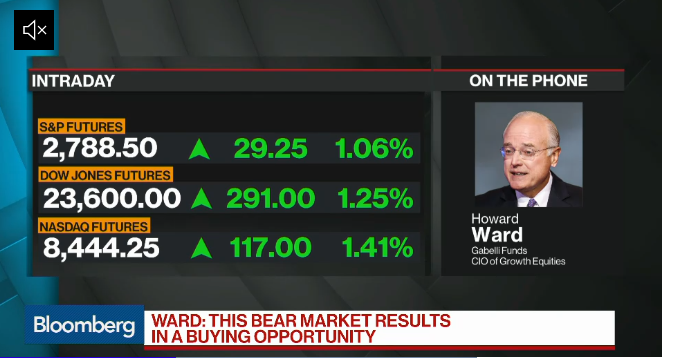
- Futures on the S&P 500 Index increased 1.4% as of 8:34 a.m. New York time.
- Nasdaq 100 Index futures climbed 1.1%.
- The MSCI Asia Pacific Index rose 1.7%.
- The MSCI All-Country World Index rose 0.6%.
Currencies
- The Bloomberg Dollar Spot Index decreased 0.3%.
- The euro increased 0.5% to $1.0969.
- The British pound gained 0.5% to $1.2579.
- The Japanese yen strengthened 0.4% to 107.33 per dollar.
Bonds
- The yield on 10-year Treasuries dipped four basis points to 0.73%.
- The yield on two-year Treasuries decreased one basis point to 0.23%.
- Germany’s 10-year yield fell one basis point to -0.36%.
- Spain’s 10-year yield rose five basis points to 0.836%.
Commodities
- West Texas Intermediate crude sank 3.7% to $21.58 a barrel.
- Iron ore climbed 1.6% to $84 per metric ton.
- Gold strengthened 0.9% to $1,730.20 an ounce.
- LME copper rose 3.1% to $5,176.50 per metric ton.
U.S. index futures advanced with European and Asian stocks on Tuesday at the outset of one of the most uncertain earnings seasons on record, with the coronavirus pandemic upending the global economy. Gold rose toward a fresh seven-year high.
Contracts on the three main American equity gauges all held their gains after JPMorgan Chase & Co., Wells Fargo & Co. and Johnson & Johnson helped kick off the reporting period. All three climbed in pre-market trading. An increase in the Stoxx Europe 600 Index took the benchmark briefly to 20% above its 2020 closing low, into territory some consider a bull market, before paring some gains.
The appetite for risk carried over from Asia, where all the major equities benchmarks jumped more than 1.5%, with the exception of Hong Kong’s. Treasuries climbed, while the dollar dipped versus most of its biggest peers. Oil futures fell as doubts swirled about whether the historic output cuts were enough to fuel a rebound.
Earnings have begun with some of the world’s biggest banks, giving investors their first glimpse of how bad the hit to global profits will be. JPMorgan and Wells Fargo set aside more than $12 billion combined for bad loans, the biggest provisions in at least a decade for both banks. Fidelity International analysts expect earnings to almost halve at companies globally this year. Traders are also focusing on whether trillions of dollars in stimulus and rescue plans will sustain a rally in risk assets when the infections curve flattens.
“Investors are doing the right thing, which is essentially writing off 2020 earnings, or at least the first two or three quarters,” Howard Ward, CIO of growth equities at Gabelli Funds, told Bloomberg TV. “The big risk to this market, and one thing that I think could send this market down to new lows, is a May 1 or a premature opening of the economy.”
In the latest developments, India and France extended their lockdowns and the British government is weighing similar steps. U.S. governors formed coalitions for the reopening of their economies, even as President Donald Trump insisted he alone has that authority.
Read: A Daredevil’s Guide to a Very Wild Earnings Season
Elsewhere, Chinese metals prices rose after March trade figures beat expectations, with stronger readings for both imports and exports in yuan terms.
In focus this week:
- U.S. banks and financial firms continue reporting first-quarter earnings, with Wednesday bringing Citigroup Inc., Bank of America Corp. and Goldman Sachs Group Inc.; BlackRock Inc. is set for Thursday.
- South Korea holds parliamentary elections and the Bank of Canada has a rate decision Wednesday.
- Also Wednesday, U.S. retail sales are poised to fall in March by the most ever.
- China releases GDP, industrial production and retail sales and jobless figures Friday.