
U.S. Stock Futures Hit Limit-Up; Treasuries Slip: Markets Wrap

These are the main moves in markets:
Stocks
- Futures on the S&P 500 Index rose 5.1% as of 7:19 a.m. New York time.
- The Stoxx Europe 600 Index surged 6.5%.
- The MSCI Asia Pacific Index dipped 1.9%.
- The MSCI All-Country World Index climbed 0.9%.
Currencies
- The Bloomberg Dollar Spot Index increased 0.2%.
- The euro declined 0.3% to $1.1153.
- The British pound decreased 0.1% to $1.2556.
- The Japanese yen weakened 1.7% to 106.45 per dollar.
- The Mexican peso strengthened 1.8% to 21.5477 per dollar.
Bonds
- The yield on 10-year Treasuries increased seven basis points to 0.87%.
- The yield on two-year Treasuries decreased one basis point to 0.47%.
- Germany’s 10-year yield jumped 11 basis points to -0.63%.
- Japan’s 10-year yield rose 11 basis points to 0.054%.
Commodities
- West Texas Intermediate crude jumped 5.5% to $33.22 a barrel.
- Iron ore climbed 0.5% to $87.60 per metric ton.
- Gold strengthened 0.8% to $1,588.21 an ounce.
- LME zinc increased 3.3% to $2,002 per metric ton.
U.S. equity futures jumped with European stocks, helping stabilize markets following the worst Wall Street session since 1987. Treasuries slipped while the dollar edged higher.
Contracts on the S&P 500 and Nasdaq 100 indexes reversed earlier declines and gradually rebounded to hit their upper trading curbs. The Stoxx Europe 600 Index jumped as regulators including those in Italy and Spain banned short-selling on some stocks. Gainers were led by Roche Holding AG, which said it won emergency approval in the U.S. for a highly automated coronavirus test, potentially speeding up the ability to diagnose patients by a factor of 10. Asia’s main equity benchmark fell.
With investors worried that emergency fiscal and monetary packages will fall short of staving off a global recession, markets remained exceptionally volatile. Investors said there’s less liquidity in the U.S. Treasury market, where 10-year notes swung from earlier gains to losses. Sovereign bonds sank across Europe for a second day amid criticism of European Central Bank measures to address the virus. Oil pushed higher and the dollar advanced.
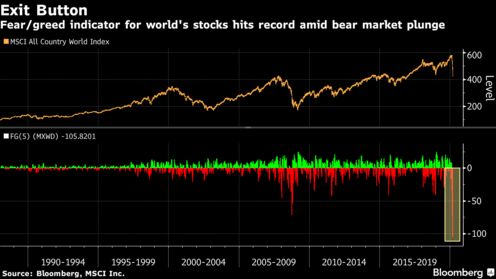
Global equities are heading for their worst week since 2008 as investors price in a severely weaker economic outlook due to the coronavirus pandemic. They’re doubting the efficacy of policy responses as cases continue to grow across the world and restrictions on people and businesses crush sentiment. The Bank of Japan on Friday followed an earlier move from the Federal Reserve to inject liquidity, and later offered to buy $1.9 billion of bonds in an unscheduled operation.
“It seems that the more severe things become in the short term, the more extreme will be the fiscal and monetary policy response,” Mark Dowding, CIO at BlueBay Asset Management, wrote to investors. “It is very conceivable that the full boost from such measures will only really kick in just as activity rebounds, with pent up demand leading to a turbo-charged recovery in the second half of the year in the wake of an economic contraction in the context of the first half.”
U.S. House Speaker Nancy Pelosi said she’s near an agreement with the Trump administration on a bill to mitigate impact from the virus. Fifty million jobs may be lost in the tourism industry globally, the World Travel and Tourism Council estimated. China’s Central Bank said it would pump in $79 billion to bolster the economy.
Britain’s chief scientific officer defended the government’s move to abandon efforts to contain the outbreak and Australia’s minister of home affairs, who met Ivanka Trump last week, said he had the disease. The global death toll topped 5,000 after Iran reported another surge in cases and fatalities.