
U.S. Stock Futures Whipsawed While Dollar Jumps: Markets Wrap
These are the main moves in major assets:
Stocks
- Futures on the S&P 500 Index climbed 0.6% as of 12:32 p.m. London time.
- The Stoxx Europe 600 Index dipped 1.4%.
- The MSCI Asia Pacific Index fell 0.1%.
Currencies
- The Bloomberg Dollar Spot Index gained 1.2%.
- The British pound dipped 1.3% to $1.2109.
- The Japanese yen fell 1% to 106.86 per dollar.
Bonds
- The yield on 10-year Treasuries increased seven basis points to 0.79%.
- Germany’s 10-year yield climbed seven basis points to -0.39%.
- Britain’s 10-year yield rose five basis points to 0.491%.
Commodities
- West Texas Intermediate crude climbed 0.2% to $28.76 a barrel.
- Gold decreased 1.9% to $1,485.30 an ounce.
Volatility continued to roil global financial markets as investors struggle to adjust to an unprecedented upheaval in social interactions that looks set to plunge the world into recession.
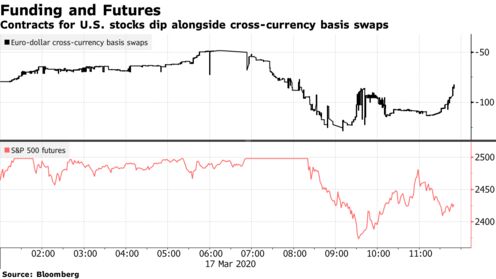
U.S. stock futures swung wildly, Treasuries slipped and stresses appeared in the short-term funding and front-edit credit markets. S&P 500 futures clung to a 1% gain, but only after wiping out a rally that took it to upper trading bounds overnight. Treasuries declined, reversing part of a nearly 25 basis-point surge on Monday. The dollar bolted higher versus major peers.
European bonds declined, while the Stoxx Europe 600 Index swung from a big gain to a loss. Equities in Asia endured a similarly tumultuous session.
American stocks slumped into the closing bell on Monday after President Donald Trump warned of a possible recession, with economic disruption from the coronavirus potentially extending into summer. Data showed U.S. retail sales fell in February, indicating the main driver of the economy, consumer spending, had begun to slow even before outbreak containment measures began.
In the latest attempts to stem the spread of the virus, Hong Kong was set to issue its second-highest travel alert for residents and extend quarantine measures for people coming from abroad. The Philippines became the first country to shut its financial markets, though it aims to reopen Thursday.
“A bear market does not preclude rallies,” said Eleanor Creagh, market strategist at Saxo Capital Markets. “In fact, the biggest rallies can be in bear markets — erratic swings are exacerbated by the present high-volatility regime and strained liquidity conditions. With VIX remaining significantly above the long-term equilibrium, alarm bells are still sounding and traders should be wary of relief rallies.”
After the Federal Reserve and other central banks dramatically stepped up efforts to stabilize capital markets and liquidity, traders are looking to fiscal authorities for action. While Congress is still working on a package, New Zealand announced a NZ$12.1 billion ($7.3 billion) plan and Australia’s government is preparing to scale up just days after announcing a A$17.6 billion ($10.7 billion) initiative.
Elsewhere, Australian stocks posted their biggest jump since 1997 while benchmarks in Hong Kong and China saw more muted moves. The yuan weakened, with economists starting to forecast a contraction in China’s economy for the current quarter. Emerging-market shares fell and oil fluctuated.